
When was the last time you got a full health check-up?
Did you read?
A couple of weeks ago, a news shook me completely.
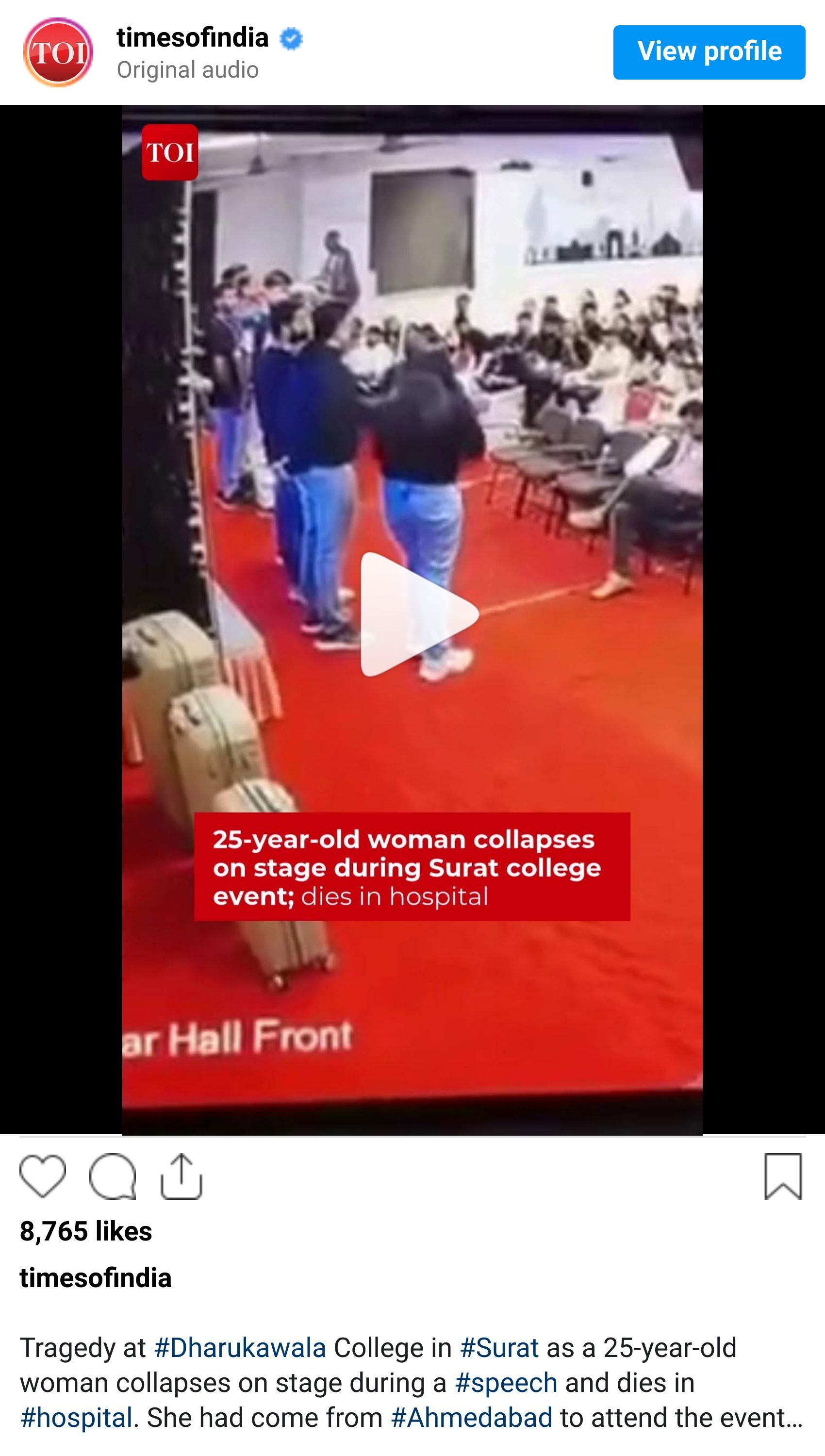
A 24-year-old IT professional from Ahmedabad, Zeel Thakkar (young, educated, travelling for work, speaking on stage) finished her talk, stepped away from the mic, and her body simply gave up. Cardiac arrest!
What unsettled me wasn’t just her age, it was how ordinary her day looked until it wasn’t.
She woke up, travelled, worked, presented… and then disappeared out of her life.
We’ve all scrolled past versions of this exact story.
Someone collapsing at a wedding, someone dying mid-workout, someone in their twenties failing to wake up.
We shrug, maybe whisper “how shocking,” and move on.
But the number of these incidents tells you something is off, even if nobody has language for it yet.

Growing up, I never saw health as something to manage. It was automatic.
You played, you ate, you slept, the world around you kept you alive.

Almost double.
Ischaemic heart disease alone is now the single biggest reason Indians lose healthy years of life.
Indians also develop heart disease at least a decade earlier than Western populations.
Our parents thought infections would be our great threat, the likes of malaria, pneumonia, tuberculosis.
We grew up fearing cancer.
Meanwhile, a different enemy arrived wearing office clothes.
According to the WHO, if you’re 30 and Indian today, you have roughly a 23% chance of dying from one of four major non-communicable diseases (cardiovascular diseases, cancer, diabetes, or chronic lung disease) before you hit 70.
Today, 1 in 4 Indian adults has diabetes or pre-diabetes, 1 in 4-3 has high blood pressure, often undiagnosed, and almost 1 in 4 Indians aged 15-49 is overweight or obese.
We don’t talk about it, but everyone you know either has medication, “borderline sugar,” “is working on BP,” or “needs to get fit again.”
And most of us aren’t even 40.
What changed in 30 years?
It’s tempting to tell ourselves this is about “lifestyle choices,” but three generations lived radically different bodies.
Our grandparents’ bodies were shaped by walking, manually cooked food, and pauses.
Our parents worked hard but still had routines. Sunday sabzis, family lunches, evening walks, TV news at fixed times.
My generation?
We built an economy of convenience and named it progress, while slowly trading away the rituals that regulated our hardware.
Dinner is online orders, movement is steps tracked by an app, recovery is postponed, sleep is “optional” if ambition demands it.
Have we outsourced physical labour, but not the stress it guarded against?
Add the invisible accelerators.
India has some of the world’s worst air quality; pollution was linked to ~1.67 million deaths in 2019, many through heart disease and stroke.
We are sleeping less, and global research shows chronic short sleep raises cardiovascular risk by 20-48%.

Now overlay that with the Indian template = late-night calls for US clients + doomscrolling till 1 a.m. + early-morning commutes + weekend “catch-up” work.
We are genuinely the first generation trying to run our hearts on 4-6 hours of sleep and espresso.
Then there’s the social side.
Loneliness itself has become measurable, social disconnection raises mortality risk to the same level as smoking 15 cigarettes a day, as we noted in our previous edition.
We are the first generation trying to run metabolism, meaning, belonging and ambition on a tired nervous system.

Cardiologists keep saying versions of the same sentence now, “Why am I treating 29-year-olds?”
The answer is surely not just genetics.
I felt it land when a friend called saying he had “gastritis-like pain.”
Two hours later, he had two stents.
Now he sends voice notes before big calls saying, “Give me five minutes, I need my walk.”
Seeing someone overhaul their life in days shows the body stepping in to enforce the rules we avoided.
Young people don’t look sick, but they present late, and sicker than they think.
They see 20- and 30-year-olds with heart blockages that shouldn’t belong to people with healthy faces.
This is India’s paradox, material progress, fractured protection.
We built roads, start-ups, ambition, but traded the things that protect the heart = walking, slow food, sleep, social ties, time.
And biology doesn’t recognise convenience as safety.
Then there’s the food environment.
Ultra-processed everything. Oil that’s been fried and re-fried.
Salt in every packet, sugar in every drink.

One ICMR study had to politely point out that our “chutki bhar namak” is way above what the WHO recommends, and directly contributes to hypertension and stroke risk.
Did our grandparents eat ghee? Yes.
Did they sit 9-10 hours a day, stare at screens, sleep at 2 a.m., live in AQI 350 air, and drink three coffees to function? No.
So when you mix = bodies under chronic low-grade stress, bad air and bad sleep, food designed for cravings, not health, and a lot of people doing life without real community, you get arteries carrying much more than blood.
why under 35
We were told to “work now, enjoy later.”
But bodies don’t do delayed billing.
They send invoices in real-time, through fatigue, breathlessness, arrhythmia, and collapse.
Parents are confused because they grew up in embodied environments. Less pollution, fewer screens, slower days.
Young people are confused because modern life was marketed as vitality, not depletion.
We dropped the anchors and never replaced them.
You cannot out-exercise cortisol. You cannot “push through” chronic stress forever.
The heart keeps score.

I keep coming back to that Harvard longitudinal study, eight decades long. Its most stubborn finding wasn’t diet, cardio, or career.
People who felt held, who felt known, aged better. The body literally buffers pain and disease differently when it feels accompanied.
Which makes you wonder whether India’s sudden youth heart epidemic is actually less about clogged arteries and more about chronically dysregulated nervous systems.
Large cohort studies across the world keep finding that around 80% of premature heart disease and stroke can be prevented with a combination of four boring things.
Not smoking, a decent diet, regular physical activity, and managing blood pressure and diabetes.
Hope remains on the table, the question is whether we act on it.

If you’re under 35 reading this, the point is not to make you panic every time your chest feels weird.
It’s to suggest that you treat your heart like you treat your finances. Boring, regular check-ins; small adjustments now; less drama later.

If you’re a parent reading this, it’s to gently say, your kids’ hearts are growing up in a different India than yours.
The threats aren’t just infections and “cold drink is bad”.
It’s the screen time, the sedentary academic & working years, the junk food, the air, the pressure.
I’m writing this as someone very much inside the problem, not above it.
I’ve had the “maybe I should get an ECG this year” thought and pushed it to “next month” more times than I’d like to admit.
Writing this is my way of putting it in my own calendar too.
If our hearts are going to be asked to carry the weight of this new India. Its air, its hours, its loneliness, what is one small, boring, un-dramatic thing you’re willing to change this month to give yours a chance?
Hit reply and tell me, even if it’s just “I’ll finally book that test.”
I read every mail.
Until next week,
Ritesh
